BAFA Module 3 subsidy: Everything you need to know
BAFA Module 3 offers companies an attractive opportunity to receive financial support for energy-efficient measures. In this article, we answer the most important questions about BAFA funding so that you can make the most of funding opportunities.

Volatile electricity prices, rising grid fees and the pressure to decarbonise are making intelligent energy management an increasingly important competitive factor for industrial companies. To support businesses in modernising their energy infrastructure, BAFA Modul 3 subsidises investments in sensor technology, measurement, control and regulation technology (MSR), as well as energy management software.
The subsidy is particularly relevant for energy-intensive manufacturing companies, complex commercial operations, logistics businesses and industrial sites. It enables companies to reduce long-term energy costs, accelerate decarbonisation through electrification and manage energy flows more transparently.
In this article, you will learn:
- what BAFA Modul 3 includes
- which measures are eligible for funding
- which requirements apply
- how high the funding rates are
- and why intelligent energy management systems are becoming increasingly important for industrial companies
What is BAFA Modul 3?
BAFA Modul 3 is part of the “Federal Funding for Energy and Resource Efficiency in the Economy” (“Bundesförderung für Energie- und Ressourceneffizienz in der Wirtschaft”). It supports companies investing in:
- measurement, control and regulation technology (MSR)
- sensor technology
- energy management software
According to the Federal Office for Economic Affairs and Export Control (“Bundesamt für Wirtschaft und Ausfuhrkontrolle”), the programme particularly supports measures for the:
“efficient control of energy and material flows for integration into an energy or environmental management system”. (translated by encentive)
The aim is to provide detailed insights into energy consumption, improve process efficiency and reduce long-term electricity, energy carrier and CO₂ costs.
Which measures are eligible under BAFA Modul 3?
BAFA Modul 3 supports a wide range of technologies related to intelligent energy management.
Eligible measures at a glance
Among others, BAFA Modul 3 supports:
- energy management software such as flexOn by encentive
- sensor technology for recording energy and material flows
- measurement, control and regulation technology
- data loggers and gateways
- analogue-to-digital converters
- actuators for automated control
- cloud-based energy management software
- training courses for software usage
- cabling and installation
- creation of a measurement concept by external service providers
BAFA states:
“The acquisition and installation of energy management software as well as staff training are eligible for funding.” (translated by encentive)
For industrial companies, the combination of:
- sensor technology,
- real-time data,
- and intelligent control
is particularly relevant. Only by integrating these components into a listed energy management software solution can energy flows be systematically analysed and optimised.
BAFA Modul 3 list: Which software is eligible?
An essential requirement for funding is the use of listed energy management software. Visualising energy flows creates the basis for optimisation.
BAFA defines:
“Energy management software is an electronic data processing technology which consolidates and automatically analyses measurement data in accordance with DIN EN ISO 50001.” (translated by encentive)
Only software solutions listed in the official BAFA Modul 3 list (“Liste förderfähiger Energiemanagement-Software”, status June 2026) are eligible.
These solutions must:
- analyse energy performance indicators
- enable monitoring
- track energy targets
- support processes according to DIN EN ISO 50001
Important: The software must follow the PDCA cycle (“Plan-Do-Check-Act”).
Special case within Modul 3: Intelligent energy software – visualisation AND control
While BAFA Modul 3 originally focused mainly on visualisation, modern software can do significantly more today. Instead of only displaying figures, solutions such as flexOn by encentive actively control systems.
The following assets can be controlled, among many others:
- production line systems, such as screw manufacturing processes that can operate flexibly without personnel dependency
- cold storage facilities, which can be cooled during low-price periods and operated with reduced loads during expensive periods
- heat pumps and ventilation systems
- industrial transport vehicles
- electric trucks (E-LKW), whose charging loads are often limited by the grid connection point
- Power-to-Heat systems
- battery storage systems
By intelligently and predictively controlling multiple assets simultaneously, companies can achieve significant cost savings.
Why sensor technology and energy management software must be considered together
BAFA places strong emphasis on integrating sensor technology into listed energy management software.
The guideline states:
“A prerequisite for funding under Modul 3 is that the eligible MSR hardware is integrated into a listed energy management software.” (translated by encentive)
This means:
Sensors alone are not enough. Savings are only achieved through the processing, analysis and, in the case of flexOn, intelligent control of energy data.
For industrial companies, this creates entirely new energy opportunities:
- reducing peak loads to lower capacity charges
- complying with high-load time windows
- managing energy flows more transparently
- lowering electricity procurement costs through spot market participation
Modern energy management systems enable:
- real-time monitoring
- automated control
- AI-based analyses and intelligent load shifting
Which companies can apply for BAFA funding?
The funding is available to companies across nearly all sectors, including:
- small and medium-sized enterprises (SMEs)
- large enterprises
- manufacturing companies
- logistics companies
- trading companies
- energy-intensive industrial businesses
BAFA Modul 3 is particularly relevant for companies with:
- high peak loads
- complex energy flows
- battery storage systems
- multiple locations
- energy-intensive production processes
With flexOn, flexible sub-processes can be shifted intelligently. Our customer projects show that most industrial companies have highly attractive flexibility potential within secondary processes.
How high is the funding under BAFA Modul 3?
The funding level depends on company size, investment type and the applicable funding framework at the time of application.
As of May 2026, the following funding rates apply:
Funding rates overview
* SME definition in German according to EU Recommendation 2003/361/EC of the European Commission.
For technically and economically related measures, grants of up to €20 million can be applied for. This enables large-scale investments even for major industrial companies.
According to BAFA, the funding is provided “under Article 38 of the AGVO” and refers to the total eligible investment costs.
Which requirements apply for the funding?
To qualify for funding, several requirements must be fulfilled.
Key requirements
1. Use of listed software
The energy management software used must appear on the official BAFA Modul 3 list (“Liste förderfähiger Energiemanagement-Software”, status June 2026).
Our software flexOn is listed and therefore eligible for funding at the subsidy rates shown above.
2. Focus on energy efficiency
BAFA only supports measures:
“which primarily serve the purpose of improving energy and resource efficiency.” (translated by encentive)
3. Proof of energy data
The recorded energy performance indicators must be stored for at least three years.
4. Technical system concept required
A technical system concept must be submitted for sensor technology and MSR systems.
This must describe:
- data acquisition
- sensor integration
- integration into the energy management software
Additionally, an impact diagram (“Wirkplan”) and a data acquisition plan must be provided.
5. Minimum operational period: 3 years
BAFA specifies under section 3.7:
“The subsidised investments must be operated for their intended purpose for at least three years after commissioning.” (translated by encentive)
Further conditions apply regarding resale or decommissioning of the subsidised investment.
Which measures are not eligible?
Many companies underestimate this aspect during the application process.
The following are generally not eligible:
- maintenance
- software updates
- licence renewals
- monitors
- printers
- servers
- conventional building management systems
- general process control systems without an energy efficiency focus
BAFA clearly distinguishes between general operational technology and energy efficiency-focused visualisation and control systems.
With the future-proof solution flexOn by encentive, companies can ensure compliance with these requirements.
How the BAFA Modul 3 application process works
To successfully benefit from BAFA Modul 3 funding, companies require preparation, technical data and the correct documentation. Especially for investments in sensor technology and energy management software, technical requirements and funding conditions should be considered at an early stage.
Our step-by-step guide shows how to apply for BAFA funding.
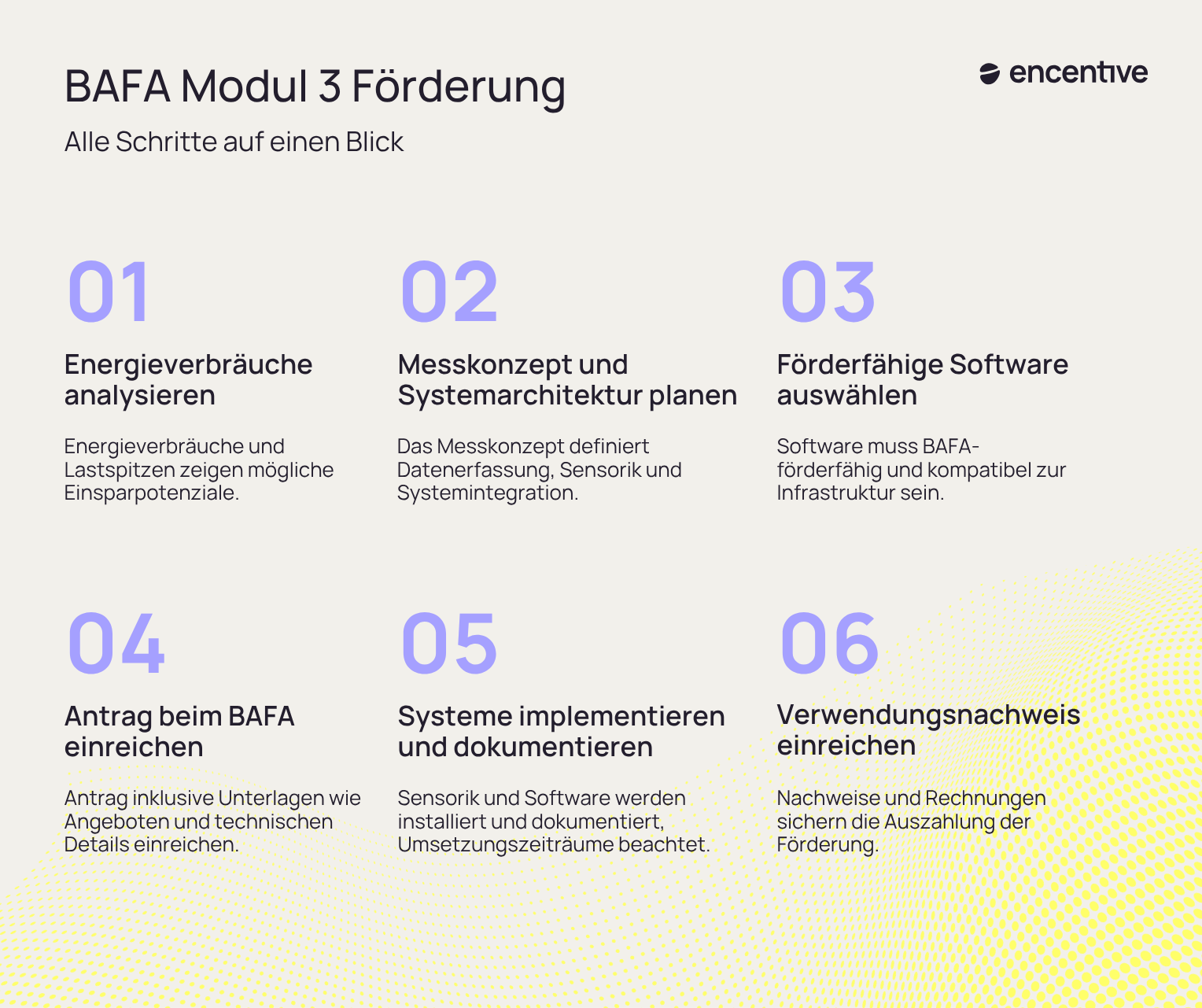
1. Analyse energy consumption
The first step is to analyse energy consumption and peak loads in order to identify savings potential and relevant energy consumers.
Modern energy management systems (EMS) such as flexOn by encentive help visualise energy flows transparently and uncover optimisation potential. While modern software solutions can go far beyond visualisation, this functionality is generally considered the basis of all EMS platforms.
Important:
Please do not begin any optimisations or installations before receiving approval from BAFA. Measures that have already started cannot subsequently be claimed for funding.
Planning activities may already take place in advance according to BAFA regulations. However, implementation measures and software activations should only begin after full approval has been granted.
2. Plan the measurement concept and system architecture
Following the energy analysis, companies define:
- which data will be collected
- which sensor technology is required
- and how the integration into the energy management software will be implemented
BAFA requires a comprehensible system concept including a data acquisition concept and a so-called “Wirkplan”, illustrating energy flows between systems.
We therefore recommend preparing a detailed technical concept. We are happy to support you with this process. Book an appointment here.
3. Select eligible software
The energy management software used must be listed in the official BAFA Modul 3 list (“Liste förderfähiger Energiemanagement-Software”, status June 2026) and must be compatible with the existing or newly installed sensor technology.
The flexOn platform by encentive was specifically developed for industrial companies and enables the centralised analysis and control of energy flows in real time.
We can integrate the vast majority of industrial assets into the control system, creating strong connectivity across relevant industrial infrastructure.
Additional important factors:
- The software should be understandable for all relevant employees.
- Existing sensor systems and control/readout equipment should be compatible with the software.
- The energy management software should fit your infrastructure long term.
Modern systems can integrate a wide range of assets, on-site generation systems and procurement structures around PPAs and dynamic electricity market prices. This keeps companies flexible even under future regulatory and energy market developments.
4. Submit the application to BAFA
The application is submitted through the BAFA portal.
Required documents typically include:
- technical descriptions
- quotations
- information about the software and hardware used
Important:
Implementation should only begin after the application has been submitted or approved.
Companies generally receive feedback from BAFA within three to six weeks.
5. Implement and document the systems
After approval, the technical implementation of the measure begins.
This includes:
- installation of the sensor technology
- setup of communication components for connection with systems such as flexOn by encentive
- software integration
- documentation of the implementation as proof of successful execution
Specific implementation deadlines apply depending on the type of modernisation or modification. These timelines are specified in the official BAFA guideline.
6. Submit proof of use (“Verwendungsnachweis”)
After completion of the project, the “Verwendungsnachweis” must be submitted to BAFA.
This includes:
- invoices
- proof of payment
- proof of commissioning
Once BAFA has reviewed and approved the final report and supporting documents, the BAFA Modul 3 funding is paid out.
On average, this process takes approximately three to six months.
Although energy management systems are often continuously improved and maintained, only the initial purchase and installation are eligible for funding. Maintenance costs and future software upgrades are not subsidised.
Intelligent energy management for industrial companies: Why BAFA funding matters
Transitioning to modern energy management solutions often delivers rapid savings, but investment costs can be substantial. BAFA funding helps reduce this financial risk.
This is particularly important in times of energy crises such as those related to Iran, Ukraine and increasing pressure from CO₂ pricing mechanisms, whose long-term impacts remain difficult to predict.
In discussions with industrial companies, several key pressures repeatedly emerge:
- volatile electricity prices
- rising grid fees
- decarbonisation requirements
At the same time, modern energy management systems unlock significant opportunities:
- peak shaving for atypical grid usage and reduced capacity charges (Bandlastprivileg)
- insights through visualisation and forecasting
- optimisation based on market prices to reduce procurement costs
- automated control of energy flows
These objectives can be achieved more effectively using assets commonly found in industrial operations:
- battery storage systems
- photovoltaic systems (PV)
- flexible secondary processes
- cooling and heating systems
- large electricity consumers such as charging infrastructure for E-LKWs and EVs or Power-to-Heat systems
This creates a highly promising but complex energy system that requires intelligent optimisation.
How encentive supports industrial companies with Modul 3
encentive first creates transparency around energy consumption and then uses this data to automatically determine the ideal operating schedule for your assets using AI-driven optimisation.
This enables companies to reduce energy costs while simultaneously decarbonising their sites.
The intelligent energy management platform flexOn combines:
- sensor technology and a broad range of energy assets
- real-time data from weather, load profiles and regulatory frameworks
- automated asset control
- AI-based optimisation
This creates a holistic energy management solution for industrial applications.
Companies can receive public funding of up to 45 % for this transformation.
The flexOn platform by encentive is officially listed as BAFA-eligible energy management software and fulfils all BAFA Modul 3 requirements.
Discover the publicly funded path towards:
- lower energy costs
- greater transparency across industrial energy flows
- improved utilisation of the grid connection point
- higher operational efficiency
Let us identify the energy flexibility potential within your business together and turn energy into a strategic competitive advantage.
We support companies throughout the BAFA Modul 3 funding process with individual consultation and expertise gained from optimising more than 100 industrial sites.
Book an appointment with our encentive experts and take the first step towards BAFA Modul 3 investment funding.
Read on


5 criteria for the integration of economic commercial battery storage
Commercial battery storage systems offer massive potential for cost reduction and independence. However, the right control system — intelligent and with multi-use functionality — is crucial.

Industrial Electricity Price and AgNes: Why Flexibility is Now the New Gold
The energy transition is fundamentally transforming the German electricity market. The 2026 industrial electricity price and the AgNes grid fee reform, set to take effect in 2029, represent two key regulatory developments designed to ease the burden on energy-intensive companies while simultaneously steering them toward greater flexibility.

Optimising HGV charging infrastructure & reducing network charges
Uncontrolled charging of electric HGVs can cause electricity costs to skyrocket. We show you how to optimise your HGV charging infrastructure, avoid expensive grid connection cost contributions and benefit from favourable spot market prices.
.png)
Energy management software: why monitoring will no longer be sufficient in 2026
Modern energy management software must not only make energy flows visible, but actively control them. The article outlines which features are essential today, how automated control enables savings from day one, and which solution is particularly well suited to mid-sized companies.
Energy market 2026: what developments companies can expect
2026 will bring noticeable relief for companies in terms of electricity and gas costs, but many of these measures are temporary. Learn which energy policy changes are ahead, why price volatility will continue to increase and why companies need to make their energy supply more flexible in the long term.

Energy management system comparison – The best EnMS
This article shows which energy management systems genuinely move companies forward — from classic monitoring tools to intelligent auto-pilot solutions. We compare five leading EnMS providers and explain which functions are essential for transparency, efficiency and active optimisation. The conclusion: modern systems that automatically control energy flows deliver the greatest benefit.

Industrial electricity price: meaningful subsidy or misplaced incentive?
Hardly any other cost factor shapes German industry as strongly as the price of electricity. For years, companies have warned about internationally uncompetitive energy prices and the risk of losing competitiveness. With the planned industrial electricity price, the German government aims to provide relief from 2026 onwards. But is this subsidy really the right approach? A closer look shows that the concept remains controversial – and raises fundamental questions about the future of Germany’s energy policy.
Effects of the technical error on the spot market
The day before last Wednesday, there were horrendous electricity prices on the electricity exchange due to a technical error. This was expensive for some industrial companies — our customers were protected by intelligent energy management.

How the slowed expansion of renewables drives electricity prices up
If the expansion of renewable energies slows down, electricity prices in Germany could rise by up to 25% by 2045. A scenario analysis shows how this would weaken competitiveness and the country’s attractiveness as an industrial location.
Power grid in Oranienburg overloaded: A proposed solution
Last week, various media reported on the electricity shortage in Oranienburg, the causes and the reaction of energy suppliers. Since such cases could occur more frequently in the future, we will look at possible solutions in the following article.

Optimising electricity costs: How companies reduce expenses
Rising energy prices and increasing market volatility are making electricity cost optimisation a key economic lever for many companies. Learn how flexible tariffs, dynamic grid fees, and targeted load management can help reduce energy costs sustainably.

Why companies rely on energy management
There are many reasons why companies are looking for innovative energy management. Based on the experiences and feedback from our customers, we have summarised the three biggest challenges.
Record figure: 280 hours of negative electricity prices
Rising price fluctuations are a reality and will continue to increase. For industrial companies, they open up opportunities: those who react flexibly reduce costs and gain a competitive advantage.

Saving energy in companies made easy
Saving energy is becoming increasingly important for companies – not only for ecological reasons, but also for economic reasons. In this blog article, we will show you why it is worthwhile to reduce energy consumption, what measures you can take and how an energy management system can help.

How to recognize a good battery simulation?
More and more companies are planning to invest in battery storage systems. Whether to cut peak loads, optimize self-consumption or as part of a multi-use approach: Expectations are high. But storage is bought too often before it is clear what it can really do in a specific application. A well-founded battery simulation can prevent just that.

Storing electricity without batteries: Smart alternatives for companies
In a changing energy system, the ability to store and control energy is increasingly becoming a competitive advantage - especially for industrial companies. But this does not always require classic battery storage systems. Companies can store electricity without batteries - by intelligently utilizing existing systems and processes.

Coalition agreement 2025: What is in store for industry now
The 2025 coalition agreement brings new drive to energy policy. The new federal government (CDU, CSU, SPD) is committed to climate neutrality by 2045 — with specific goals for more renewable energy, digitalization and, above all, more flexibility in the energy system. For industrial companies, this means that energy optimization is becoming a strategic success factor.

The most important facts about energy efficiency for companies
The importance of energy efficiency for companies is constantly growing. Both environmental responsibility and cost savings have a decisive impact on their competitiveness. In this article, we take a closer look at the most important facts about energy efficiency and show how companies can improve it.

The new flexible grid charges for industrial customers
The German Federal Grid Agency is planning to adjust the regulations for individual grid charges for industrial customers. As a result of the energy transition, the framework conditions of the energy system are currently changing. The new regulations, which were set out in the recently published key point paper on Section 19 (2), should take this into account.

The development of electricity prices on the exchange until 2030
How will electricity prices on the exchange develop in the future? A recent study shows how renewable energy, rising gas and CO₂ prices and the nuclear phase-out are shaping the market. In this article, you can read about the challenges and opportunities this presents to industry.
Why it pays to flexibilize your company's electricity consumption
Making electricity consumption more flexible is becoming increasingly important in industry. Companies are faced with the challenge of rising electricity prices, fluctuating energy generation and network utilization. Flexible electricity consumption can help to reduce costs and operate more sustainably. But what does that mean in practice?

The winners and losers of negative electricity prices
The recently adopted solar package in Germany has brought negative electricity prices back into the public eye. We explain how they arise, what problems are associated with them and how companies benefit from negative electricity prices.