Industrial Electricity Price and AgNes: Why Flexibility is Now the New Gold
The energy transition is fundamentally transforming the German electricity market. The 2026 industrial electricity price and the AgNes grid fee reform, set to take effect in 2029, represent two key regulatory developments designed to ease the burden on energy-intensive companies while simultaneously steering them toward greater flexibility.

It is now clear: The European Commission has officially approved Germany’s €3.8 billion state aid program through the end of 2028. This marks a significant step forward for the industrial electricity price. The relief is set to apply retroactively starting January 1, 2026, and applications are expected to be accepted starting January 1, 2027. It is therefore crucial for companies not only to wait for the relief but to assess their eligibility, data situation, and potential for flexibility now.
What is the industrial electricity price?
The industrial electricity price is a government support instrument designed to temporarily alleviate the electricity costs of particularly electricity-intensive companies in Germany. The scheme has been approved by the European Commission under state aid rules and is set to apply retroactively starting January 1, 2026. The goal is to provide short-term support to energy-intensive industrial companies, prevent relocations, and ensure their international competitiveness. Simply put: For a portion of industrial electricity consumption, the effective electricity price is to be reduced or subsidized on a calculated basis. However, the relief does not apply across the board to every company, nor does it automatically apply to the entire electricity consumption. Whether a company can benefit depends, among other things, on its industry, primary economic activity, WZ code, electricity consumption, electricity costs, and the final regulatory requirements.
Key aspects of the Industrial Electricity Price:
- Approval: Approved under state aid law on April 16, 2026, case number SA.120495
- Duration: Through the end of 2028
- Effective Date: Retroactive to January 1, 2026
- Application: Expected to be available starting January 1, 2027
- Target price: approximately 5 ct/kWh or 50 €/MWh
- Subsidy amount: Reduction in the electricity price of up to 50% of the reference price
- Reference price: Average of the previous year’s base futures
- Subsidy volume: Expected to be up to 50% of a production facility’s electricity consumption
- Financing: Through the Climate and Transformation Fund
Thus, the industrial electricity price is not a permanent electricity pricing model, but rather a temporary relief measure. This makes the question of how companies can strategically leverage this potential subsidy all the more important.
Which companies can benefit from the industrial electricity rate?
The industrial electricity rate is intended for electricity-intensive companies that face international competition. The decisive factor is not only the level of electricity consumption, but also whether the company’s specific economic activity can be classified as belonging to a relevant sector or subsector.
The KUEBLL list and the WZ code play a central role in this regard.
KUEBLL stands for Climate, Environment, and Energy Aid Guidelines. These European state aid guidelines define the conditions under which countries may support companies in the context of energy and climate policy. You can view the current version of the KUEBLL here (starting on page 80).
In the context of the industrial electricity price, this logic is important because it classifies sectors and subsectors that may be considered particularly energy-intensive, electricity-cost-intensive, and exposed to international competition.
The WZ code describes a company’s economic activity. It is important for assessing the industrial electricity price because eligibility is often tied not only to broad industry categories but also to specific activities.
For example, a company may operate in the metal industry, chemical industry, plastics processing, food industry, or paper industry without automatically being eligible for support. The precise classification is decisive.
Companies should therefore assess the following at an early stage:
- Which WZ code is on file?
- What primary economic activity does it describe?
- Does the specific subsector potentially fall under the relevant EU guidelines?
- What are the current electricity consumption levels and costs?
- What relief measures are already being utilized?
- What investments in decarbonization, efficiency, or flexibility are planned?
What requirements must companies meet?
Funding through the Industrial Electricity Price program is intentionally tied to specific conditions. Companies are expected to use this relief not only to reduce their electricity costs in the short term, but also to invest a portion of it in transformation, decarbonization, and efficiency.
As things stand, companies must reinvest at least 50% of the funding they receive within a specified period.
Possible investments include, for example:
- Decarbonization measures
- Energy efficiency projects
- Electrification measures
- Load management
- Storage
- Smart energy management software
- Measures to increase demand flexibility
Thus, the Industrial Electricity Price is not merely viewed as a subsidy, but as a potential lever for investment. Companies can use the relief to make their energy infrastructure more flexible and cost-efficient.
The Flexibility Bonus: Why flexibility is becoming particularly relevant
The flexibility bonus is particularly relevant. Companies can receive a 10% increase in the amount of aid if they invest a significant portion of their matching contribution in measures to increase demand flexibility.
The basic logic:
- The flexibility bonus amounts to an additional 10% on top of the subsidy.
- The prerequisite is that at least 80% of the counter-performance obligation or the relevant investment amount is directed toward measures to increase demand flexibility.
- At least 75% of the additional bonus must, in turn, be reinvested in countermeasures or decarbonization measures.
This makes flexibility not only sensible from an energy economics perspective but also attractive from a funding perspective.
However, it is important to clarify this point: Flexibility measures are not automatically free of charge. The bonus, however, can significantly improve their economic viability and offset a large portion of the costs on paper.
Sample Calculation: Industrial Electricity Prices as a lever for flexibility
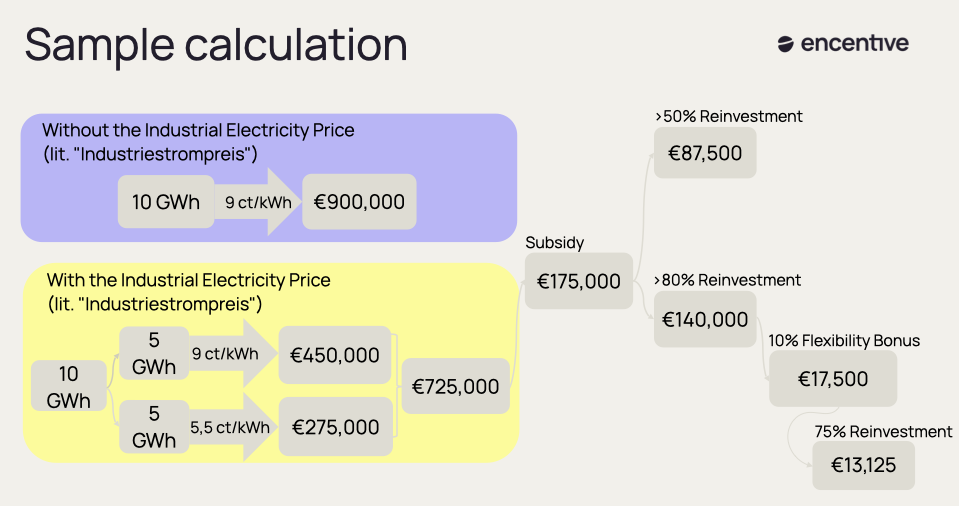
The following simplified example illustrates how industrial electricity prices can affect a company with an annual electricity consumption of 10 GWh.
Without subsidies, the electricity costs in this example amount to €900,000.
With the industrial electricity price, they drop to €725,000 —
resulting in a calculated cost savings of €175,000.
However, it is not just the short-term cost reduction that matters. A portion of the subsidy must be reinvested. If a particularly high proportion is invested in measures to increase demand flexibility, the flexibility bonus may also come into play. Thus, the industrial electricity price becomes not only a cost relief but also a potential investment lever for load management, storage, or smart energy control.
The chart provides an overview of the simplified logic involving electricity costs, subsidies, reinvestment, and the flexibility bonus.
What is still unclear at this time
Even though the industrial electricity price is now much more specific, not all details have been finalized.
In particular, the following remain open or need to be worked out in detail:
- the specific BAFA application process
- forms and the online portal
- requirements for providing proof of electricity consumption, industry, and WZ code
the final funding guidelines - Details regarding retroactive payments
- Specific requirements for reinvestments and flexibility measures
- Practical evidence for the flexibility bonus
For companies, this means: While it is not yet possible to submit a final application, preparations can certainly be made. Those who compile data, load profiles, WZ codes, and investment plans early on will be able to react more quickly once the process begins.
What is the AgNes Grid Fee Reform?
With the General Electricity Grid Fee System (AgNes), the Federal Network Agency is planning a fundamental reform of grid fees in Germany. It is set to take effect in 2029 and will adapt the grid fee system to an electricity system that is increasingly characterized by renewable energy and greater fluctuations in availability.
Until now, the grid fee structure has been heavily based on rigid consumption profiles. Companies with constant electricity consumption have often been able to benefit from grid fee reductions, for example through the band load privilege.
However, with the growing share of wind and solar energy, the logic of the electricity system is changing. Electricity is no longer available at a constant, steady rate but fluctuates depending on weather, generation, and grid utilization.
Update August 2026: The new draft clarifies the rules
The general direction of AgNes was already known. The current draft regulation now provides much greater clarity on how the new grid fee structure for industrial customers is to function starting in 2029.
- Ordered Capacity Is Specified
In the future, companies will be required to specify grid capacity for each year. The new draft now also defines specific limits: Ordered capacity must generally be at least 10% of the previous year’s individual annual peak load and no more than 100% of the contractually agreed-upon grid connection capacity.
This makes it even more important to determine how much power a site actually needs and how reliably this demand can be planned and managed.
- AP1 and AP2 specify the costs for exceeding capacity limits
Two energy prices are now specifically regulated: AP1 applies to electricity consumption within the reserved capacity. If this limit is exceeded, AP2 applies to consumption during those periods.
AP2 is intended to range between 200 and 350% of AP1.
This presents companies with a new optimization challenge: The contracted capacity should be selected as efficiently as possible without regularly causing cost-intensive overages.
- A transition period begins for § 19 (StromNEV) customers
The roadmap is also becoming clearer for existing individual grid fees. Atypical grid usage and band-load arrangements may continue for certain existing customers until the end of 2031.
This means that 2029 will not mark a complete break for today’s Section 19 customers. At the same time, it is becoming clear that the current approach of rigid consumption profiles is not intended to continue unchanged in the long term.
For industrial customers, this shifts the central question: How much grid capacity do I really need—and how reliably can I manage my consumption within that capacity?
Flexible consumers, storage, and smart energy management can help ensure that the selected capacity is used efficiently and that overages are avoided.
Industrial Electricity Price and AgNes: the transition to a flexible electricity system
The industrial electricity price is not merely a short-term relief measure for energy-intensive companies. It can also be viewed as a bridge to the AgNes grid fee reform.
While the industrial electricity price is intended to lower electricity costs in the short term starting in 2026, AgNes will change the economic logic of grid fees starting in 2029. Both developments point in the same direction: flexibility is becoming a key factor for energy costs and competitiveness.
The link between the two instruments lies particularly in the flexibility bonus. Companies that invest in flexibility measures can benefit from lower electricity costs in the short term while simultaneously preparing strategically for the future grid tariff system.
At the same time, the federal government plans to introduce a capacity market starting in 2032. This market is intended to ensure the availability of controllable capacity following the phase-out of coal. In this context, not only generation will be relevant, but also the provision of capacity for grid stabilization—for example, through industrial flexibility.
For companies, the development of the electricity market means above all:
- Electricity costs are becoming more dependent on time and the grid.
- Flexibility is becoming a competitive economic advantage.
- Energy management is becoming increasingly strategically important.
- Controllable loads, storage, and load management are gaining in importance.
- Companies can prepare for future market mechanisms today.
We explain in more detail how companies can make their electricity consumption more flexible in the article “Why It Pays to Make Your Company’s Electricity Consumption More Flexible.”
Why companies should act now
Even though the final details still depend on regulatory decisions, it’s worth starting to prepare now. Companies should review their data, evaluate 15-minute load profiles, and analyze controllable loads, storage systems, PV, charging infrastructure, and planned investments in efficiency, decarbonization, or flexibility.
This will reveal early on whether eligibility is possible—and how the industrial electricity price can be specifically leveraged for load management, smart energy control, and permanently lower electricity costs.
How industrial companies can prepare now
Developments surrounding industrial electricity prices, AgNes, and the capacity market clearly show that flexibility will become a key economic factor for industrial companies in the future.
Those who begin early to align their energy consumption with these trends will be better able to take advantage of short-term incentive programs and benefit from new market mechanisms in the long term.
Short-term measures
Companies should check the following now:
- Is the company generally eligible?
- What WZ code is on file?
- Does the primary economic activity potentially fall under a relevant KUEBLL sector?
- What is the annual electricity consumption?
- What are the current electricity costs?
- Are 15-minute load profiles available?
- Are there controllable loads or processes that can be shifted?
- Are storage systems, PV, charging infrastructure, cooling, heating, or compressed air available?
- What investments in efficiency, decarbonization, or flexibility are already planned?
- What impact would the industrial electricity price have on electricity procurement, investments, and energy costs?
Some good first steps are:
- Conduct a load profile analysis or potential analysis
- Assess flex-readiness
- Incorporate the 2026 industrial electricity price into budget and investment planning
- Simulate the economic viability of commercial energy storage systems, power-to-heat, load management, or energy management software
- Examine how smart energy management can automatically leverage existing flexibility
- Prepare relevant documentation and consumption data
Mid- and long-term measures
In the medium and long term, companies should not view flexibility in isolation but rather integrate it into a holistic energy strategy.
This includes:
- automatic control of energy-intensive loads
- smart energy management software
- integration of energy storage systems
- better utilization of PV and self-consumption
- dynamic electricity procurement
- reduction of peak loads
- preparation for flexible grid tariffs
- flexibility as a strategic lever for operating costs
Our partnership with FlexPower for real-time electricity procurement and energy management illustrates how electricity procurement and energy management can be more closely integrated.
The key point: Flexibility not only reduces costs in the short term but also increases our ability to respond in an increasingly volatile electricity system.
Conclusion: Responding Intelligently to the Industrial Electricity Price and AgNes
The 2026 industrial electricity price can provide significant relief to energy-intensive companies. At the same time, it is temporary, subject to specific conditions, and is no substitute for a long-term energy strategy.
Starting in 2029, AgNes will also change the grid fee structure and provide greater economic incentives for flexibility. Companies should therefore consider both developments together: short-term relief through the industrial electricity price and long-term cost advantages through flexible management.
What matters is not only who can benefit from the industrial electricity price—but also how companies utilize the potential relief. Those who assess their eligibility, load profiles, and flexibility potential now can strategically use the subsidy as a stepping stone toward lower electricity costs, fewer load peaks, and smarter energy management.
Partners such as encentive help companies identify flexibility potential, evaluate investments from an economic perspective, and intelligently manage energy consumption. If you’d like to explore the potential within your company, you can receive a free, no-obligation consultation.
Read on


5 criteria for the integration of economic commercial battery storage
Commercial battery storage systems offer massive potential for cost reduction and independence. However, the right control system — intelligent and with multi-use functionality — is crucial.

Optimising HGV charging infrastructure & reducing network charges
Uncontrolled charging of electric HGVs can cause electricity costs to skyrocket. We show you how to optimise your HGV charging infrastructure, avoid expensive grid connection cost contributions and benefit from favourable spot market prices.
.png)
Energy management software: why monitoring will no longer be sufficient in 2026
Modern energy management software must not only make energy flows visible, but actively control them. The article outlines which features are essential today, how automated control enables savings from day one, and which solution is particularly well suited to mid-sized companies.
Energy market 2026: what developments companies can expect
2026 will bring noticeable relief for companies in terms of electricity and gas costs, but many of these measures are temporary. Learn which energy policy changes are ahead, why price volatility will continue to increase and why companies need to make their energy supply more flexible in the long term.

Energy management system comparison – The best EnMS
This article shows which energy management systems genuinely move companies forward — from classic monitoring tools to intelligent auto-pilot solutions. We compare five leading EnMS providers and explain which functions are essential for transparency, efficiency and active optimisation. The conclusion: modern systems that automatically control energy flows deliver the greatest benefit.

Industrial electricity price: meaningful subsidy or misplaced incentive?
Hardly any other cost factor shapes German industry as strongly as the price of electricity. For years, companies have warned about internationally uncompetitive energy prices and the risk of losing competitiveness. With the planned industrial electricity price, the German government aims to provide relief from 2026 onwards. But is this subsidy really the right approach? A closer look shows that the concept remains controversial – and raises fundamental questions about the future of Germany’s energy policy.
Effects of the technical error on the spot market
The day before last Wednesday, there were horrendous electricity prices on the electricity exchange due to a technical error. This was expensive for some industrial companies — our customers were protected by intelligent energy management.

BAFA Module 3 subsidy: Everything you need to know
BAFA Module 3 offers companies an attractive opportunity to receive financial support for energy-efficient measures. In this article, we answer the most important questions about BAFA funding so that you can make the most of funding opportunities.

How the slowed expansion of renewables drives electricity prices up
If the expansion of renewable energies slows down, electricity prices in Germany could rise by up to 25% by 2045. A scenario analysis shows how this would weaken competitiveness and the country’s attractiveness as an industrial location.
Power grid in Oranienburg overloaded: A proposed solution
Last week, various media reported on the electricity shortage in Oranienburg, the causes and the reaction of energy suppliers. Since such cases could occur more frequently in the future, we will look at possible solutions in the following article.

Optimising electricity costs: How companies reduce expenses
Rising energy prices and increasing market volatility are making electricity cost optimisation a key economic lever for many companies. Learn how flexible tariffs, dynamic grid fees, and targeted load management can help reduce energy costs sustainably.
Why companies rely on energy management
There are many reasons why companies are looking for innovative energy management. Based on the experiences and feedback from our customers, we have summarised the three biggest challenges.
Record figure: 280 hours of negative electricity prices
Rising price fluctuations are a reality and will continue to increase. For industrial companies, they open up opportunities: those who react flexibly reduce costs and gain a competitive advantage.

Saving energy in companies made easy
Saving energy is becoming increasingly important for companies – not only for ecological reasons, but also for economic reasons. In this blog article, we will show you why it is worthwhile to reduce energy consumption, what measures you can take and how an energy management system can help.
How to recognize a good battery simulation?
More and more companies are planning to invest in battery storage systems. Whether to cut peak loads, optimize self-consumption or as part of a multi-use approach: Expectations are high. But storage is bought too often before it is clear what it can really do in a specific application. A well-founded battery simulation can prevent just that.

Storing electricity without batteries: Smart alternatives for companies
In a changing energy system, the ability to store and control energy is increasingly becoming a competitive advantage - especially for industrial companies. But this does not always require classic battery storage systems. Companies can store electricity without batteries - by intelligently utilizing existing systems and processes.
Coalition agreement 2025: What is in store for industry now
The 2025 coalition agreement brings new drive to energy policy. The new federal government (CDU, CSU, SPD) is committed to climate neutrality by 2045 — with specific goals for more renewable energy, digitalization and, above all, more flexibility in the energy system. For industrial companies, this means that energy optimization is becoming a strategic success factor.

The most important facts about energy efficiency for companies
The importance of energy efficiency for companies is constantly growing. Both environmental responsibility and cost savings have a decisive impact on their competitiveness. In this article, we take a closer look at the most important facts about energy efficiency and show how companies can improve it.

The new flexible grid charges for industrial customers
The German Federal Grid Agency is planning to adjust the regulations for individual grid charges for industrial customers. As a result of the energy transition, the framework conditions of the energy system are currently changing. The new regulations, which were set out in the recently published key point paper on Section 19 (2), should take this into account.

The development of electricity prices on the exchange until 2030
How will electricity prices on the exchange develop in the future? A recent study shows how renewable energy, rising gas and CO₂ prices and the nuclear phase-out are shaping the market. In this article, you can read about the challenges and opportunities this presents to industry.
Why it pays to flexibilize your company's electricity consumption
Making electricity consumption more flexible is becoming increasingly important in industry. Companies are faced with the challenge of rising electricity prices, fluctuating energy generation and network utilization. Flexible electricity consumption can help to reduce costs and operate more sustainably. But what does that mean in practice?

The winners and losers of negative electricity prices
The recently adopted solar package in Germany has brought negative electricity prices back into the public eye. We explain how they arise, what problems are associated with them and how companies benefit from negative electricity prices.